India Didn’t Burn the Planet. But It’s the One Choking.
A return to Delhi’s toxic air becomes a reckoning with the unequal history, responsibility, and human cost of the global climate crisis.
January 2, 2026 · 5 min read
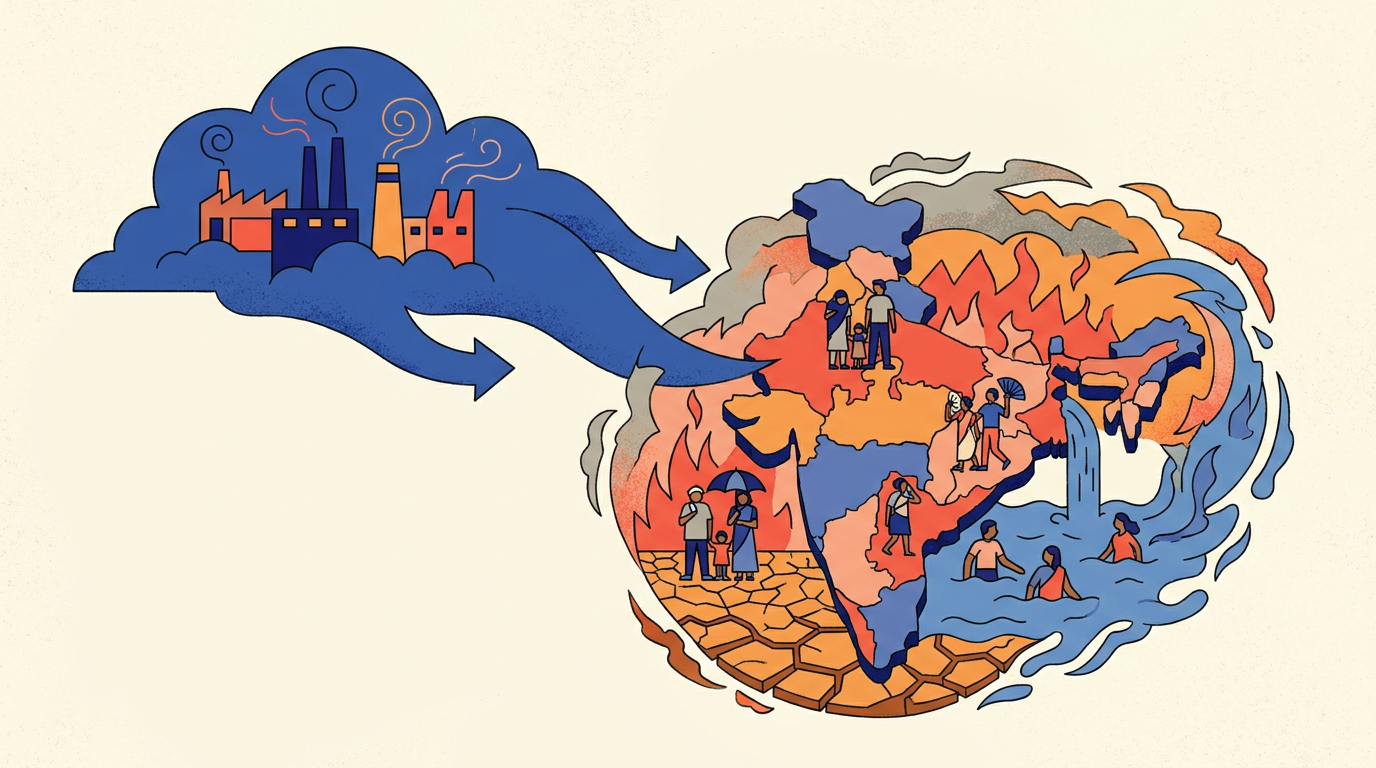
India’s climate vulnerability reflects a profound gap between historical emissions and present-day consequences.
I happened to visit India recently after spending merely two years in Canada. This was my first visit since moving. My time in Canada, though fraught with difficulties, came with its concomitant advantages: clean air, drinkable tap water, tidy roads, healthy food, and virtually no pollution. These comforts became such a part of my daily life that my lungs, heart, skin, and hair seemed to thank me for the move. Despite my cortisol levels hitting the roof almost hourly, the stress seemed to leave no visible impact on my physical health.
So much so that the moment I landed in India and stepped out of the airport, I felt queasy, nauseous — even a little disgusted. The plan was to stay for a while, to spend time with my parents. But how could I? The AQI in New Delhi was over 500. A constant smog pierced my burning eyes. The streets were littered with plastic. I was hospitalised within a day of my arrival — and again, multiple times in the first month alone.
That initial disgust, I realised, wasn’t entirely mine. It had been instilled in me — fed by the Western narrative that India lacks civil sense. And while that observation isn’t baseless, I began to dig deeper. What replaced my disgust was not shame — but pity.
The plight of my homeland isn’t the result of its own choices alone. It is the virulent consequence of what Global North countries have done — and continue to do — to the Global South. There is a stark schism between the environmental burdens borne by the South and those conveniently externalised by the North.
Step outside in an Indian summer, and you don’t need a scientist to tell you the climate is collapsing. The air scorches. The rains betray. The seasons — once sacred, poetic, rhythmic — now arrive like broken men: too early, too hard, or not at all. It has failed crops, water scarcity, unbearable summers, and unliveable cities. It is heatwaves that kill more than wars. It is rivers that dry and floods that drown within the same season. And all of this is happening in a country that, by almost every metric, has contributed the least to this crisis and is being punished the most by it.
The brutal climate India faces today isn’t karma.
It’s colonial fallout — wrapped in carbon.
India is suffering from a crisis it did not cause.
India today accounts for approximately 7% of total global CO₂ emissions, according to 2022 estimates by the International Energy Agency (IEA) and the Global Carbon Project. That is a significant contribution in absolute terms — and the Earth responds to the total volume of emissions, not how they are distributed across populations. However, in global climate negotiations, per capita emissions remain a key marker of equity and historical responsibility. On that front, India emits just 1.9 tonnes per person, compared to 15.3 in the United States, 18 in Canada, and over 7 in China.
Yet the core of the climate crisis lies not only in present-day emissions but in the cumulative atmospheric burden built up over nearly two centuries. The real crime lies in the past. And this is where the disparity becomes stark: the United States alone is responsible for nearly 25% of all historical CO₂ emissions. The European Union accounts for another 22%. By comparison, India’s contribution stands at less than 4%. That difference — between who polluted first, who polluted most, and who suffers now — is the heart of the climate injustice India continues to endure. This vast imbalance between historical responsibility and present vulnerability underscores the deep injustice at the heart of the global climate crisis.
And yet, India is at the epicentre of the suffering. It is experiencing some of the most intense, recurring climate shocks anywhere on Earth: severe droughts in central states, record-breaking heatwaves in the north, glacier lake outburst floods in the Himalayas, and rising sea levels that threaten major cities along the coast. According to the IPCC, India is among the countries most vulnerable to long-term climate impacts — and among the least prepared to absorb them due to historical underinvestment in climate-resilient infrastructure. This vulnerability is not simply a matter of geography. It is a political and economic consequence of global inaction and historical inequality.
Despite this, India is often treated in global forums as both a climate laggard and an inconvenient negotiator. This is profoundly misleading. India has consistently overperformed on its climate targets. It achieved a 24% reduction in emissions intensity of GDP between 2005 and 2016, ahead of its 2020 commitment. As of March 2024, nearly 46% of its electricity capacity comes from non-fossil sources — a staggering achievement for a country still dealing with widespread poverty, energy access issues, and basic development needs. India has committed to net-zero emissions by 2070, launched one of the world’s most ambitious carbon market frameworks, and continues to expand renewable energy deployment at a pace that rivals many richer nations. While Canada is expanding oil pipelines, and the U.S. still subsidises fossil fuels, India is betting on solar, wind, hydrogen, and aggressive electrification.
What makes this particularly unjust is the gap between contribution and consequence. The Global North — despite being responsible for the bulk of climate damage — has repeatedly failed to meet even its modest promises. The much-publicised $100 billion annual climate finance commitment, due by 2020, was never fully met. What did arrive often came as loans, not grants — deepening the debt burdens of already fragile economies. Meanwhile, loss and damage financing — meant to compensate countries for irreversible climate destruction — remains a stalled conversation, diluted by technicalities and stalled by geopolitical unwillingness.
This is what climate injustice looks like: a country that did not break the system is now forced to live within its wreckage, while being judged by the very nations that built the problem. And still, India pushes forward — experimenting with solar parks the size of cities, electrifying its transport systems, promoting sustainable consumption at the citizen level, and building global coalitions like the International Solar Alliance.
The deeper question the world must answer is not whether India is doing enough. It is whether the rest of the world is willing to face what it has done — and what it now owes.
Because India did not cause this disaster. But it is being buried beneath it. India didn’t build the world’s factories. India didn’t colonise continents. India didn’t burn coal for 150 years before talking about morals. But it will lose its coastlines. It will bury its farmers. It will choke on the smoke of someone else’s progress. This is the climate caste system, and India is being forced to swallow the sins of the industrial elite.
It is not the villain. It is not a free-rider. It is not the problem. It is the scapegoat made sacrificial in a system where wealth burned carbon, and poverty inhaled it.
If the world is to survive this century, climate reparations are not charity — they are due. India didn’t burn the planet. But it’s the one choking. And it’s time we stop pretending otherwise.
Citations
1. India’s Share of Global CO₂ Emissions — IEA and Global Carbon Project
International Energy Agency (IEA). (2023). CO₂ emissions in 2022. Retrieved from https://www.iea.org/reports/co2-emissions-in-2022
Global Carbon Project. (2023). Global Carbon Budget 2023. Retrieved from https://www.globalcarbonbudget.org/carbonbudget/
2. Per Capita Emissions — World Bank and Our World in Data
World Bank. (2022). CO₂ emissions (metric tons per capita). Retrieved from https://data.worldbank.org/indicator/EN.ATM.CO2E.PC
Ritchie, H., Roser, M., & Rosado, P. (2022). CO₂ and Greenhouse Gas Emissions. Our World in Data. Retrieved from https://ourworldindata.org/co2-and-other-greenhouse-gas-emissions
3. Historical CO₂ Emissions — Our World in Data
Ritchie, H., Roser, M., & Rosado, P. (2020). Who has contributed most to global CO₂ emissions? Our World in Data. Retrieved from https://ourworldindata.org/contributed-most-global-co2
Sources & further reading
Related pieces

India’s Patriarchy Is Not a Relic of the Past. It Is Still Our Present
From unequal domestic labour and intimate-partner violence to political impunity, patriarchy remains embedded in India’s everyday institutions.
August 12, 2026 · 6 min read