India’s Patriarchy Is Not a Relic of the Past. It Is Still Our Present
From unequal domestic labour and intimate-partner violence to political impunity, patriarchy remains embedded in India’s everyday institutions.
August 12, 2026 · 6 min read
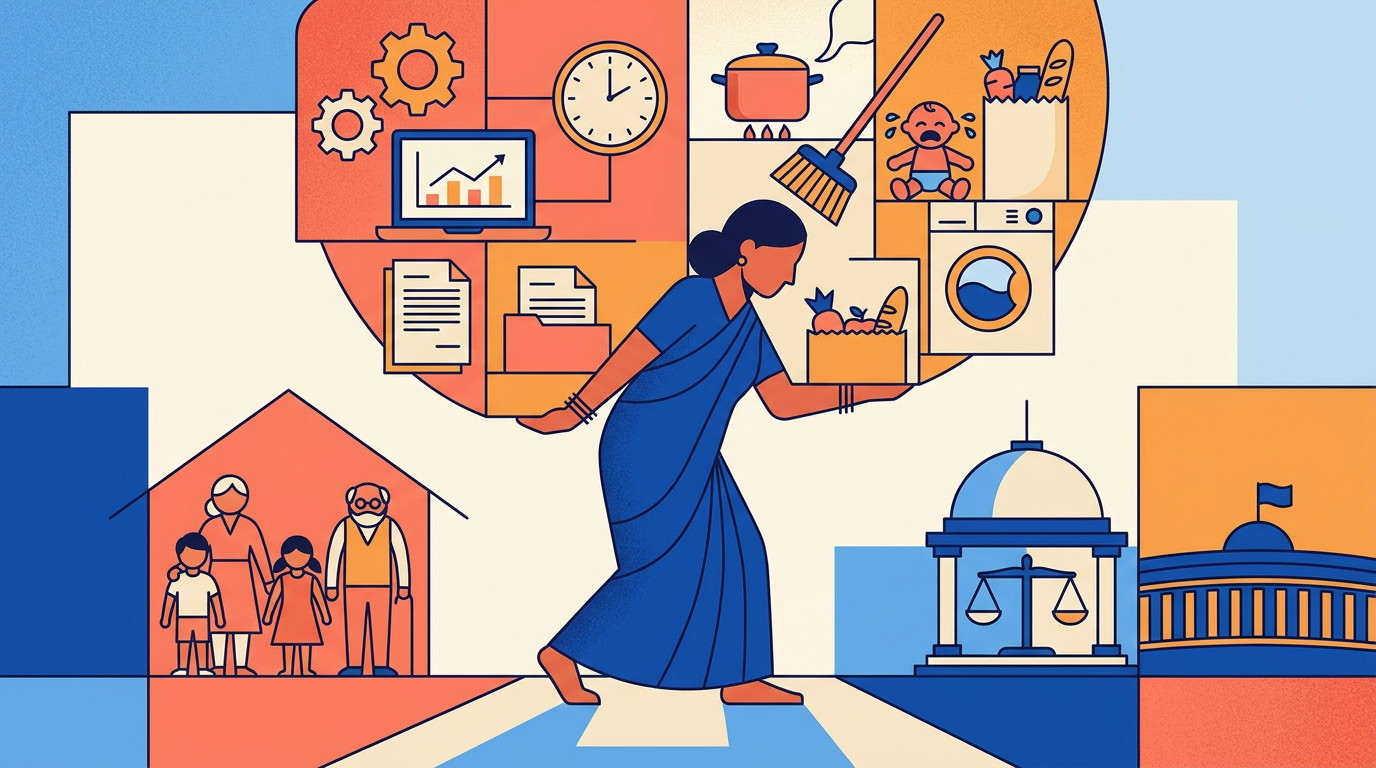
Constitutional equality has not erased the patriarchal expectations embedded in Indian homes, institutions and politics.
Growing up in India, one of the things that made me uncomfortable quite early was the way women were treated within families and society, not always through spectacular acts of violence or discrimination, but through expectations so ordinary that we rarely even stopped to question them: daughters were expected to learn how to cook and manage a household in preparation for marriage while sons were rarely raised with the same urgency; women were expected to relocate after marriage, adjust to another family, frequently adopt another surname, perform a disproportionate share of domestic work even when they had careers of their own, and somehow consider sacrifice, compromise and obedience virtues that made them better wives, daughters-in-law and mothers.
For some time, I thought this was particularly Indian, until living outside India and observing other societies made something very obvious to me: patriarchy is not an Indian invention, and countries such as Canada or the United States are certainly not free from misogyny, gendered violence, unequal domestic labour, restrictions on reproductive autonomy or the countless ways in which women continue to be treated differently from men; what makes India particularly difficult for me, however, is how many manifestations of patriarchy remain remarkably explicit, culturally normalized and woven into everyday ideas of family, marriage, honour, religion and what constitutes a “good woman.”
And this is not merely anecdotal. India’s 2024 Time Use Survey found that among people aged 15–59, 81.5% of women participated in unpaid domestic services compared with 27.1% of men, while female participants spent an average of 305 minutes a day doing this work compared with 86 minutes for men. (Source)
In other words, even as millions of Indian women have entered universities, workplaces and professions that earlier generations were systematically excluded from, the domestic expectations attached to being a woman have not disappeared at anything close to the same pace.
The contradiction becomes even more striking when we look at the principles on which modern India was founded, because Articles 14 and 15 of the Constitution guarantee equality before the law and prohibit discrimination on grounds including sex, which means equality for women is hardly some recently imported Western idea that arrived with social media or modern feminism; it has been embedded in the constitutional framework of the Republic itself.
Yet constitutional equality and social equality are very different things.
India’s own NFHS-5 found that 29.3% of ever-married women aged 18–49 reported having experienced physical or sexual violence from a spouse, meaning that almost three in ten women within that group reported violence from the very person with whom society expects them to build their lives. (Source) The preference for sons has produced consequences that begin even before birth: UNFPA estimated that between 2013 and 2017, approximately 460,000 girls were “missing” at birth in India every year, with gender-biased sex selection accounting for roughly two-thirds of that estimate. (Source)
The recorded-crime numbers are equally difficult to ignore. NCRB data show that 337,922 crimes against women were registered in 2014, compared with 445,256 in 2022, an increase of approximately 32%; these figures should not be interpreted as proof that underlying violence increased by precisely the same percentage, because reporting behaviour, awareness, population growth and registration practices matter, but neither should we pretend that the enormous number of women approaching the criminal-justice system is somehow insignificant. (Source) More than 31,000 rapes were reported in 2022 alone, while Reuters noted in 2024 that India’s rape conviction rate remained around 27–28%, despite the tougher laws introduced after the horrific 2012 Delhi gang rape. (Source)
The contradiction becomes even harder to ignore when misogyny and violence against women are not confined to private homes or anonymous perpetrators, but appear within the political system itself. A 2024 analysis by the Association for Democratic Reforms, based on the election affidavits of 4,693 sitting MPs and MLAs across India, found that 151 had declared cases related to crimes against women, including 135 MLAs and 16 MPs; the BJP had the highest number of such lawmakers at 54, and five BJP MPs or MLAs had declared cases related specifically to rape. These are declared criminal cases, not convictions, and that distinction matters, but so does the fact that political parties continue to field and empower candidates carrying allegations of this gravity. And there are cases where the criminal process has gone much further: former BJP MLA Kuldeep Singh Sengar was convicted in 2019 of raping a minor in Unnao and sentenced to life imprisonment, with the court explicitly noting the coercion and threats faced by the survivor’s family. When lawmakers themselves can be accused of, and in some cases convicted of, such crimes, patriarchy stops being merely a social attitude and becomes a question of what kinds of behaviour political institutions are willing to tolerate, normalize, or fail to decisively exclude.
When patriarchy becomes culture
Popular culture has played its part in this normalization, because generations of Indian cinema have presented the endlessly sacrificing mother, the obedient wife, the woman who tolerates humiliation to preserve her marriage, and the homemaker whose willingness to put everyone else’s ambitions before her own as symbols of feminine virtue, and while Indian cinema has certainly changed and many filmmakers have actively challenged these stereotypes, it is worth asking why submission and sacrifice were so easily accepted as aspirational qualities for women in the first place.
Religion cannot be entirely removed from that conversation either, although this article is neither an indictment of Hinduism nor an argument that patriarchy belongs to one religion, because virtually every major religious tradition has histories, texts, institutions or interpretations that women and feminist movements have had to challenge; nevertheless, when discussing India, where Hindu traditions have deeply influenced social practices around marriage, family, caste, widowhood, purity and gender roles, refusing to examine the patriarchal interpretations of those traditions simply because religion is sensitive would make any discussion of Indian patriarchy incomplete.
The issue is not whether an individual woman chooses to participate in a religious or marital tradition, because equality must include her freedom to make that choice; the issue begins when a tradition establishes expectations for women that have no meaningful equivalent for men, and society then treats those expectations not as choices but as markers of virtue, respectability and belonging.
Which brings me to sindoor.
What exactly are we celebrating when we celebrate sindoor?
Sindoor, the red vermilion traditionally worn by many married Hindu women in the parting of their hair, publicly communicates something about a woman’s marital status, and whatever spiritual, emotional or cultural meaning an individual woman may personally attach to it, there remains an obvious question that Indian society rarely seems interested in asking: why does a married woman need a visible bodily marker announcing her marriage when her husband generally does not?
The asymmetry is precisely what makes the symbol relevant to a conversation about patriarchy, because marriage changes the visible social identity of the woman in a way it does not demand of the man, and traditions around widowhood make that asymmetry even clearer, since a woman traditionally stops wearing sindoor after her husband’s death. Contemporary reporting explaining the symbolism of sindoor similarly describes it as a marker worn by married Hindu women and traditionally discontinued upon widowhood.
This would remain a cultural debate about personal choice and tradition had the symbolism not recently been elevated from private practice into the vocabulary of the Indian state itself.
On April 22, 2025, terrorists murdered 25 Indians and one Nepali citizen in Pahalgam, an atrocity that deserved condemnation without qualification, and on May 7 India responded by striking nine sites in Pakistan and Pakistan-administered Kashmir in an operation officially named Operation Sindoor. Contemporary reporting made explicit what the name represented: it invoked the sindoor of women whose husbands had been murdered in Pahalgam, transforming the loss of those men, and the grief of the women who survived them, into the emotional symbolism of the military response.
And that is precisely what I find disturbing.
Not the military response to terrorism, which is an entirely separate political and strategic debate, but the decision to narrate that response through the marital identity of the women left behind.
Because what exactly was taken from those women? Their sindoor?
Or a human being they loved?
When a woman loses her husband, why does the national metaphor for her loss have to become the disappearance of a symbol that identified her as somebody’s wife, rather than the loss of companionship, love, family, security, shared memories and another person’s life?
And if one of those victims had been unmarried but had left behind a partner, would her grief somehow have offered the nation a less powerful metaphor because there was no sindoor to erase; if a mother lost her son, a daughter her father, or a sister her brother, would those relationships somehow carry less symbolic value because none of them could be represented through a mark of marital status?
This is precisely how patriarchy survives even in societies that formally believe themselves to be progressing: not necessarily because someone announces that women are inferior, but because women’s identities continue to be narrated through their relationships with men, and traditions built upon that relationship are elevated into symbols of womanhood itself.
India has responded militarily to terrorism before without needing such symbolism, and that makes the choice even more revealing, because the name was not inevitable; it was a cultural and political choice about what image of grief would resonate with the country.
Equality was never supposed to be revolutionary
The most frustrating part of conversations about feminism in India is how frequently the demand itself is treated as though women are asking society to adopt some radical new social order, when what is being demanded is extraordinarily basic: that a woman’s ambitions matter as much as a man’s, that domestic labour belongs to everyone who lives in a household, that marriage does not transfer ownership or identity, that motherhood is not the purpose against which every woman’s life must be measured, that violence inside a marriage remains violence, and that a woman exists as a complete human being irrespective of whether she is someone’s daughter, wife, mother or widow.
None of this requires rejecting Indian culture, abandoning religion, disrespecting individual women’s choices or importing another country’s social model; it requires being willing to examine traditions with the same critical lens with which we examine every other institution, retaining what people freely find meaningful while refusing to protect inequality merely because it has existed for generations.
The Indian Constitution recognized women as equal citizens decades ago, but constitutional language can only take a society so far when everyday culture continues to assign women responsibilities, symbols, sacrifices and standards that it does not equally demand from men.
Perhaps that is the larger problem India still needs to confront: women were granted equality in the Constitution, but society continues to behave as though equality is something they are asking us for.
Sources & further reading
Related pieces
India Didn’t Burn the Planet. But It’s the One Choking.
A return to Delhi’s toxic air becomes a reckoning with the unequal history, responsibility, and human cost of the global climate crisis.
January 2, 2026 · 5 min read